
by Claire L. Brady, EdD
Bill Gates recently published a very long essay about artificial intelligence. And before anyone DM’s me: No, this is not a Bill Gates appreciation post. Gates is a complicated and polarizing figure, and there are plenty of reasons people may approach his predictions about technology, education, work, and the future with skepticism. But here's the annoying part: he makes some really good points.
Gates argues that we are entering an enormously disruptive period and that, while AI continues to advance, we are doing a pretty terrible job preparing people and institutions for what comes next. As I read his essay, I kept thinking: Bill, have you been sitting in my speeches and podcasts?
Because underneath the enormous predictions about labor markets, economic systems, global governance, and the future of humanity are several questions higher education needs to be asking right now. And frankly, they're much more important than which AI tool we're buying next.
The Entry-Level Job Problem Is a Higher Ed Problem
One of Gates's biggest concerns is what happens to work. He argues that entry- and mid-level jobs may be particularly vulnerable as AI becomes capable of taking on more of the work traditionally done by humans, and he is especially concerned about young people entering a workforce with fewer entry-level opportunities.
Higher ed should be paying very close attention to this. If the first rung of the career ladder changes, preparing students to climb the existing ladder isn't enough. We need to be asking what early-career work will actually look like and what happens when some of the tasks traditionally used to train new professionals are automated. How does someone develop judgment and expertise if AI is doing more of the foundational work that once helped them build both?
We also need to think differently about what employers will value in graduates when producing the first draft, analyzing basic data, writing routine code, conducting preliminary research, or creating a standard presentation is no longer the differentiator it once was. Career readiness in an AI era cannot simply mean adding "AI skills" to a list of competencies. It requires us to rethink what it means to prepare someone for work that is itself changing.
AI Can Help Students Learn More. It Can Also Help Them Learn Less.
This may have been my favorite tension in Gates's essay. He argues that the same technology that could allow people to learn more than ever could also result in people learning less.
Yes. This is exactly the conversation I wish we were having more often in higher ed. AI can explain a difficult concept, help a student practice, translate, brainstorm, provide feedback, increase accessibility, or give someone another way into material they don't understand. It can also do the thinking for them, and those are not the same thing.
We have spent an enormous amount of energy asking whether students are using AI. Increasingly, of course they are. The better question is whether their use of AI is strengthening or replacing the learning we actually care about. Are students still wrestling with ideas, making connections, evaluating information, developing arguments, and learning how to sit with a problem they cannot immediately solve?
Gates uses the phrase "productive struggle" when describing the kind of learning AI should preserve, and higher education should probably tattoo that one on our collective forearm. The goal isn't to make every part of learning easier. Some of the struggle is the learning.
What Should Be "Human Reserved" in Higher Education?
Gates introduces another idea I found particularly interesting: Human Reserved. His argument is that there may be work machines technically could do that we intentionally decide they shouldn't do because something important would be lost.
Higher ed needs its own version of that conversation. Not because we should draw a giant circle around everything we've always done and declare it sacred. Some of our administrative processes are practically begging for automation. Please. Let the robots have them.
But there are moments in education where efficiency isn't the point. Mentoring a struggling student, helping someone make meaning from failure, navigating an ethical dilemma, building belonging, challenging someone's assumptions, sitting with ambiguity, or helping someone discover what they are capable of are not inefficiencies to engineer out of the student experience. They are the student experience.
As AI becomes more capable, we need to get much clearer about where we want technology to extend human capacity and where human presence itself is part of the value. Just because AI can do something doesn't mean handing it over is necessarily an improvement.
Access to AI Is Not the Same as Equity
Gates also keeps returning to a question higher education cannot afford to treat as secondary: Who actually benefits? He describes AI as having the potential to become either an extraordinary equalizer or an extraordinary source of injustice. That tension should sound very familiar to anyone who has spent time thinking about access and equity in education.
The operative word throughout his essay is can. AI can expand access. It can make expertise more widely available. It can help people navigate complicated systems. It can create opportunities for people who previously lacked resources, connections, or specialized support. But none of that happens automatically.
Giving every student access to an AI tool is not the same thing as giving every student the knowledge, judgment, confidence, support, and opportunity to use it well. A student who knows how to interrogate an AI response, recognize bad information, protect their data, challenge an assumption, and decide when not to use AI has a very different kind of access than someone who simply has a login.
If we aren't careful, AI literacy itself becomes another form of privilege. Higher ed has an enormous role to play in preventing that.
Fine, Bill. We Need a Plan.
Ultimately, Gates's biggest argument is right there in the essay: we need a plan. For higher education, that doesn't mean predicting exactly what AI will look like five years from now. We can't. It also doesn't mean choosing one platform and declaring ourselves an AI-enabled institution, or forming a committee, publishing a policy, offering three workshops, and checking AI off the strategic priority list.
It means building institutions capable of navigating whatever comes next. We need to be able to make thoughtful decisions repeatedly rather than reinventing the process every time a new tool appears. We need to understand how AI is already being used across our institutions, evaluate new opportunities and risks, prepare our people rather than simply purchase technology, and adapt academic programs, student services, operations, and workforce preparation as the world around us changes.
And throughout all of that, we need to protect learning, pay attention to who benefits and who gets left behind, and be intentional about the parts of education where human presence isn't incidental to the work. It is the work.
So yes, I read Bill Gates's AI manifesto. All of it. You're welcome.
And while you certainly don't have to agree with Bill Gates about everything—I don't—the questions he raises about work, learning, equity, human connection, and our preparedness for what comes next deserve serious attention. Higher ed doesn't need Bill Gates to tell us that AI is going to change the world. Our students are already telling us that. What they need from us is to be ready to help them navigate it.
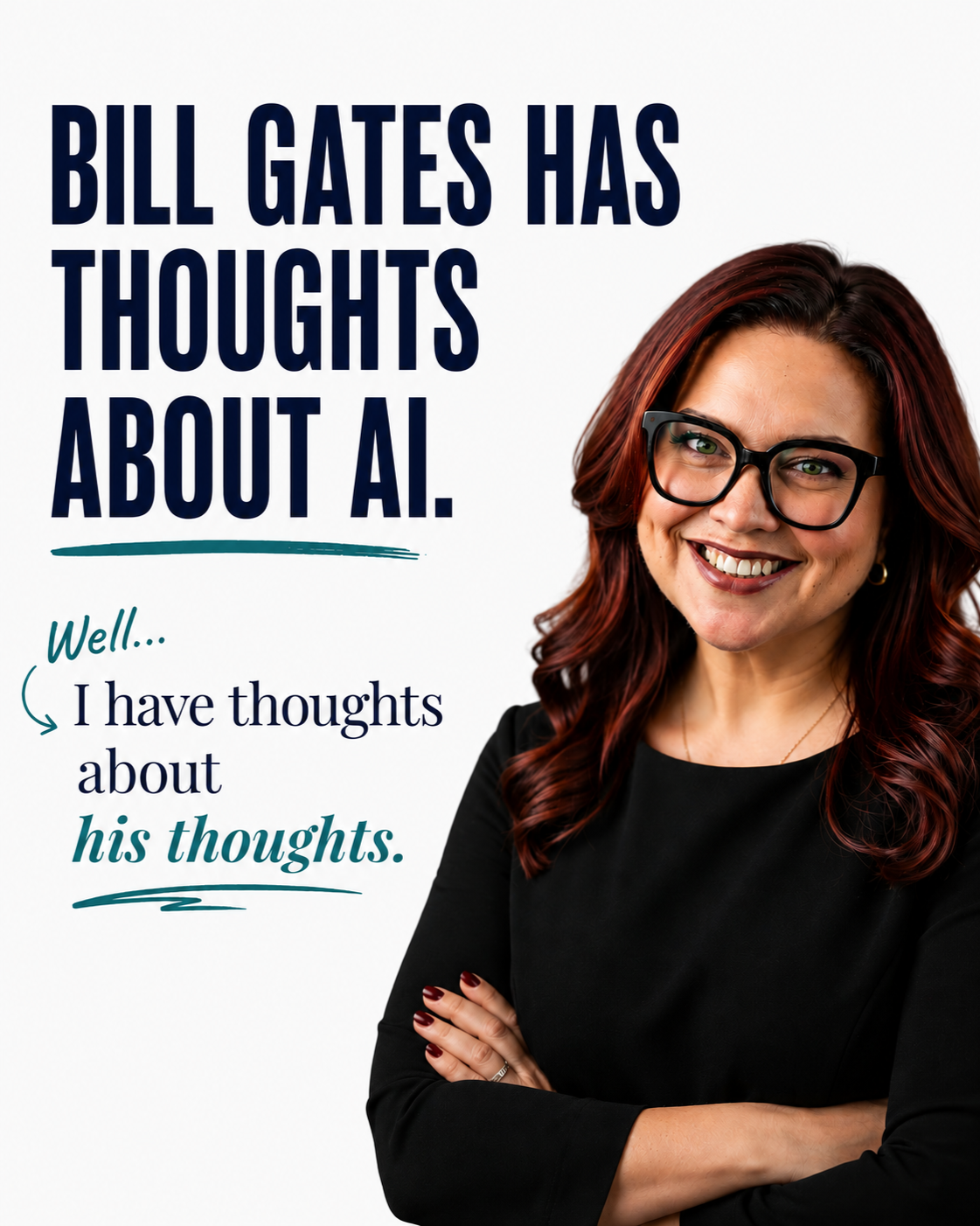
This image was created using ChatGPT
