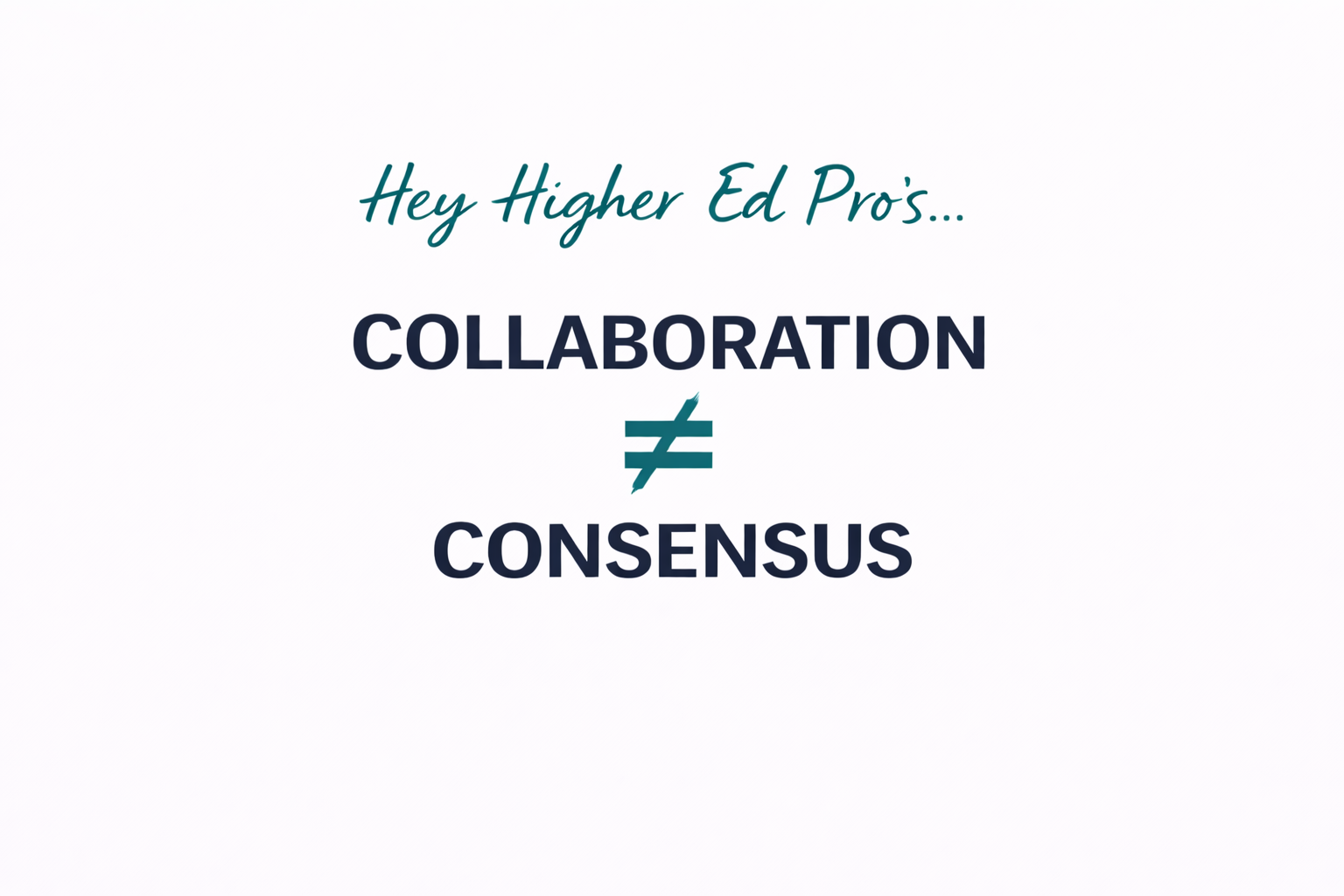
Collaboration ≠ Consensus
by Claire L. Brady, EdD
A note about this series: This is a multi-part series for higher ed pros who want to lead boldly (without turning into someone they’re not). Higher ed is full of brilliant, community-driven leaders who tiptoe through their careers using language designed to sound polite, careful, accurate, and pleasant. But here’s the truth: Language shapes perception—and perception shapes opportunity. Words can shrink your influence, or they can expand it. This series is for the quietly powerful humans who are ready to take up a little more space in their own stories—without losing their collaborative soul.
Higher education loves collaboration.
We create councils, committees, working groups, task forces, subcommittees of subcommittees—and, occasionally, a steering team whose primary task is to decide when the committee should meet again.
And to be clear: I love this about us. Truly. Collaboration is where some of our best work happens. Shared wisdom. Diverse perspectives. Smarter, more humane solutions. When collaboration is done well, it makes our institutions stronger.
But somewhere along the way, we crossed two important wires. We started treating collaboration and consensus as if they were the same thing. They’re not.
The Mix-Up That Slows Everything Down
In many higher ed spaces, collaboration has quietly come to mean: everyone must agree before anything can move. If one person is uncomfortable, hesitant, or unconvinced, the work pauses. Or worse, circles endlessly.
That’s not collaboration. That’s consensus. And while consensus has its place, it will grind innovation to a polite—and often exhausting—halt if it becomes the default.
Here’s the distinction we don’t name often enough:
Collaboration = many voices, one direction, forward motion
Consensus = all voices agree, no motion until then
One builds trust and shared ownership. The other often builds fatigue.
When Consensus Actually Matters
There are moments when slowing down and seeking broad agreement is not just appropriate, but essential.
Consensus makes sense when you’re dealing with:
New policies that affect multiple groups or units
Decisions with clear ethical, legal, or equity implications
Anything involving student safety, wellbeing, or rights
In these cases, taking the time to align deeply is responsible leadership.
When Collaboration Without Consensus Is Healthier
But not every decision needs that level of unanimity. In fact, requiring it in the wrong contexts can be counterproductive.
Collaboration without consensus is often healthier for:
Operational improvements and process tweaks
Pilots, prototypes, or early-stage experiments
Communications decisions
Any work where someone is actually accountable for outcomes
In these moments, the goal isn’t universal agreement. It’s informed movement.
Language That Moves the Work Forward
One of the most powerful tools leaders have here is language. You can honor input without giving hesitation a veto.
Try phrases like:
“I appreciate the perspectives shared. Here’s the recommended path forward.”
“We may not all agree, but we’re aligned enough to test this.”
“Let’s implement, evaluate, and adjust as needed.”
These statements acknowledge collaboration while still asserting leadership and direction.
Action Steps: Lead the Motion
If this tension shows up in your work (and it likely does), here are a few practical moves:
Clarify decision rights early. At the first meeting, name who recommends, who decides, and who implements. Ambiguity breeds frustration.
Time-limit debate. If the conversation is circling after 30 minutes, it’s often time to choose a direction and move.
Pilot over perfect. Testing something small beats designing forever. Learning happens in motion.
Name the discomfort. Saying, “This feels hard because we’re moving without 100% agreement,” can diffuse tension and normalize leadership.
A Final Word
Collaboration is courageous. It asks us to listen, integrate, and respect difference.
Consensus is comfortable. It lets us delay risk and responsibility.
Great leaders know when to choose which.
And in higher education, where the work is complex and the stakes are real, forward motion—guided by values and informed by collaboration—is often the most responsible choice we can make.