
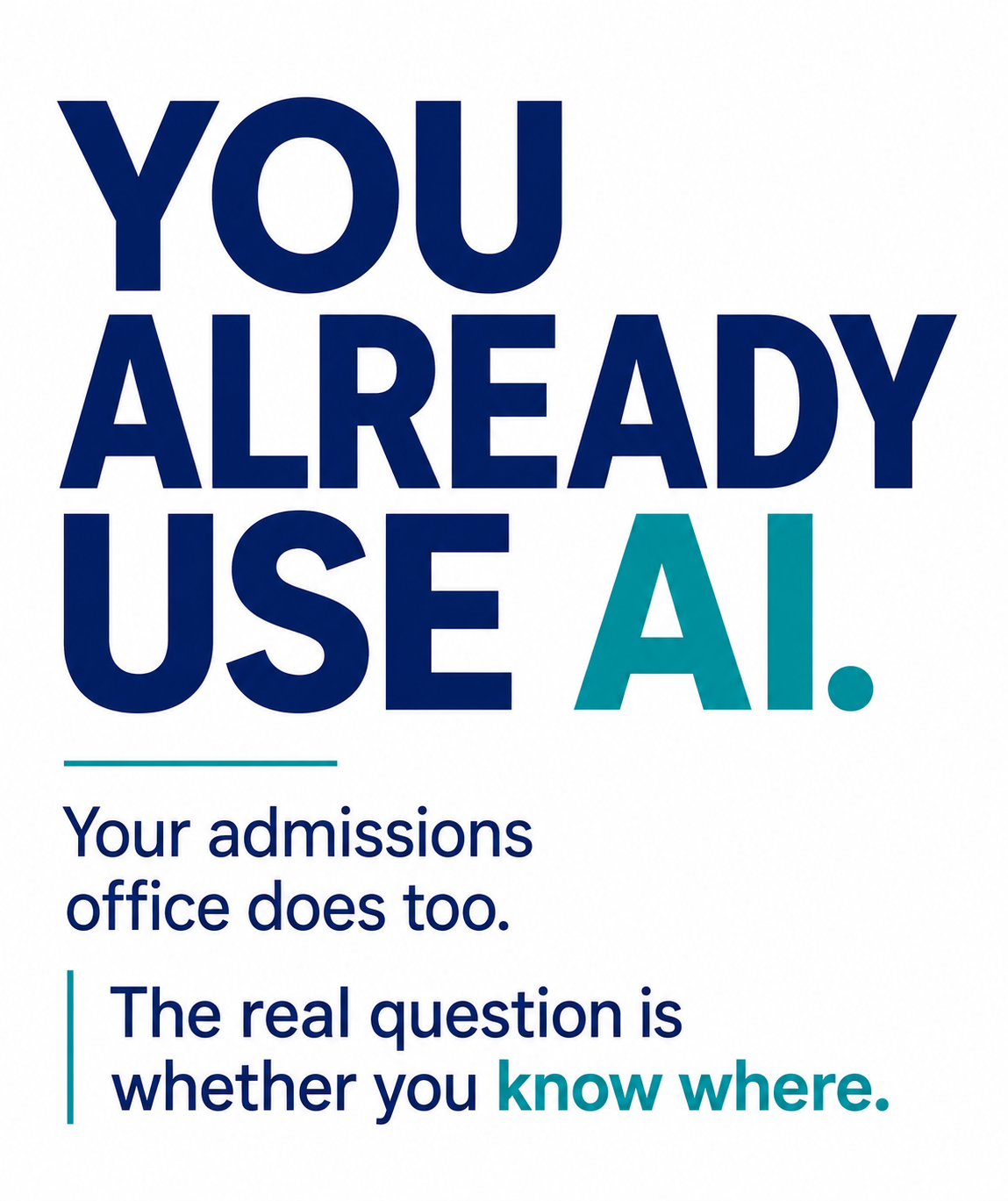
Your Admissions Office Already Uses AI. The Real Question Is Whether You Know Where.
by Claire L. Brady, EdD
Reflections on the new Student Defense / SHAPE AI report: “Dos and Don’ts of AI in College Application Evaluation”
Let’s start with an uncomfortable truth:
Most enrollment leaders are already operating in AI-adjacent environments—even if they haven’t purchased a product labeled “AI.”
Predictive modeling. CRM prioritization. application scoring. transcript parsing. chatbot triage. yield modeling. scholarship optimization. fraud detection. essay analysis. Behavioral nudges. The question is no longer whether AI belongs in enrollment management. The question is: Do you actually know where machine judgment begins and human judgment ends?
That’s why the new Student Defense and SHAPE AI report on Dos and Don’ts of AI in College Application Evaluation caught my attention. Not because it says anything particularly radical—but because it forces a conversation enrollment leaders may not be having enough.
The report offers ten recommendations around AI in admissions—including requiring human accountability, monitoring for disparate impact, increasing transparency with applicants, protecting data, and demanding stronger vendor accountability.
But underneath all ten is a deeper challenge: Many enrollment teams understand their workflows better than they understand their technology stack. That matters. Because AI doesn’t usually arrive with a dramatic policy announcement.
It arrives quietly:
A vendor adds a recommendation engine.
A CRM updates prioritization logic.
A dashboard introduces a confidence score.
A transcript reader starts classifying students differently.
And suddenly decisions feel more objective—not because they are, but because they arrived with a score attached.
One section of the report stood out to me: the recommendation to conduct use case analysis and impact assessment before deployment—and avoid piloting on live applicants until institutions can demonstrate necessity, proportionality, and safety.
Savvy enrollment leaders should read that and ask: Wait—we’re evaluating new tools that way… but are we evaluating existing ones? Because most risk doesn’t come from new AI. It comes from inherited systems operating without scrutiny.
Three questions enrollment leaders should take into planning season
1. Which enrollment decisions are currently influenced by algorithmic recommendations?
Not AI in theory—actual workflow points. Application review? Outreach sequencing? Scholarship packaging? Yield interventions? Build the map.
2. If an applicant asked, “How was this decision made?” could your team answer confidently?
Not legally. Operationally.
3. Are your enrollment KPIs creating pressure toward automation that conflicts with institutional values?
Speed, conversion, and efficiency matter. But if every incentive rewards faster processing, teams naturally drift toward over-reliance.
Here’s the thing enrollment leaders know better than almost anyone: Admissions has never been purely objective. It has always been a values exercise wrapped in process. AI doesn’t remove that reality. It just makes our assumptions visible. And institutions that understand that distinction early are going to make better decisions—not because they resisted AI, but because they refused to outsource judgment.
Read the full report: https://static1.squarespace.com/static/68a733df04d0801eecae5b19/t/6a15d0bcd811443ff7d3537a/1779814589651/AI+in+College+Admissions.pdf
Note: this image was created using ChatGPT
