
Climbing the AI Career Pyramid: What Higher Ed Leaders Need to Understand Now
by Claire L. Brady, EdD
There are moments when a single article reframes an entire conversation. “The AI Career Pyramid” published in The AI Journal on March 18, 2026, is one of those pieces.
For the past two years, much of higher education has been focused on what AI makes faster: drafting, summarizing, coding, responding. Efficiency has been the headline.
But this article names something more structural—and far more important for leaders. As AI accelerates execution, the value of execution is declining. And when value declines, it doesn’t disappear. It moves. Not upward in title. Upward in abstraction.
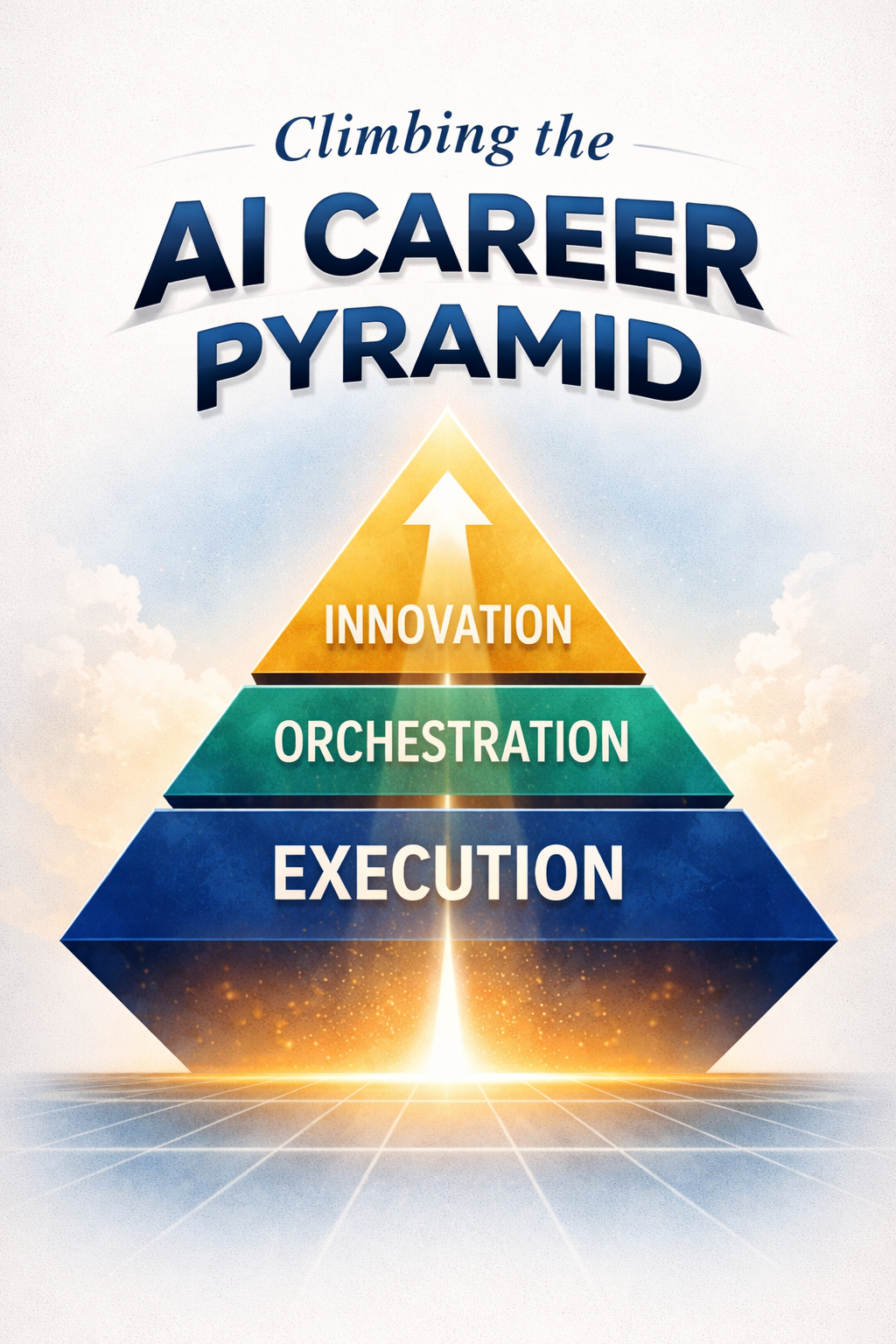
The framework is simple and powerful:
Execution → Orchestration → Innovation
And whether we are ready or not, every role on our campuses is being pulled up that pyramid.
Execution Is Becoming Baseline
The data cited in the article confirms what many of us are already sensing. Organizations like McKinsey & Company estimate that up to 60–70% of knowledge work activities are automatable. Drafting reports, summarizing data, generating communications—these are no longer differentiators. They are becoming expectations.
In higher education, this shows up quickly:
AI-generated advising notes
Automated communications flows
First-draft policy documents
Instant research summaries
This is not the future. It is already here. Which means we need to be clear with our teams: If your value is primarily execution, AI will compress it.
AI Is Not Replacing Leadership—It Is Raising the Bar
One of the most important insights in the piece is this: “AI is not automating leadership. It is automating coordination.” Research from Microsoft shows that employees spend 57% of their time on coordination—emails, meetings, searching for information.
As AI reduces that burden, something subtle but significant happens: Decision-making density increases.
Leaders—and aspiring leaders—are now expected to:
Make faster, higher-stakes decisions
Navigate ambiguity without complete information
Align stakeholders across competing priorities
Weigh ethical implications in real time
This is where many institutions are not yet prepared.
We have invested in tools. We have not yet fully invested in judgment capacity.
Orchestration Is the New Middle
The most overlooked layer in the AI Career Pyramid is orchestration.
This is the ability to:
Design workflows that integrate AI effectively
Delegate to both humans and machines
Evaluate outputs for quality, bias, and alignment
Connect systems, people, and strategy
In higher ed, this might look like:
A director who builds an AI-supported case management system
A VPSA who aligns AI use across departments with shared principles
A team leader who ensures AI outputs reflect institutional values
Orchestration is not technical expertise. It is applied leadership in an AI-enabled environment.
Innovation Is Becoming Structural
At the top of the pyramid sits innovation—but not in the way we often think about it. This is not about having the most creative ideas in the room.
It is about:
Defining problems worth solving
Setting direction in uncertain environments
Owning outcomes and consequences
Designing systems that scale
As highlighted in projections from the World Economic Forum, the fastest-growing skills are those rooted in judgment, adaptability, and complex reasoning.
In other words: The human skills we’ve always valued are now the differentiators.
What This Means for Higher Ed Leaders
This is not just a workforce trend. It is a leadership mandate.
Here are three actions to consider:
1. Redefine What “High Performance” Looks Like
Move beyond productivity and output. Reward interpretation, decision-making, and strategic thinking.
2. Build Orchestration Capacity Across Your Team
Don’t just train people on tools. Train them on how to design work with AI.
3. Invest in Judgment, Not Just Skills
Create space for ethical discussions, scenario planning, and complex decision-making practice.
The AI Career Pyramid is not a distant model. It is already reshaping our institutions. The question is not whether roles will move up the pyramid. It is whether we will prepare our people to climb it—intentionally, ethically, and together.
Read the full article here: https://www.linkedin.com/pulse/ai-career-pyramid-the-ai-journal-n2alf/
*This image was created using ChatGPT
