
Controversial Take: The Students We Say We Serve & the Systems We Still Protect
By Claire L. Brady, EdD
Higher education wasn’t built for today’s students.
We know it.
And yet—we continue to design around a version of students that no longer exists.
A recent piece by Steven Mintz in The Chronicle of Higher Education underscores this reality with clarity and urgency. He reminds us that the comprehensive American university was built for a different era—one defined by full-time students, stable funding, and a shared understanding of what college was for. That world is gone. And still, much of our structure remains.
As a first-generation college student—and a first-generation American—higher education was never an abstract system to me.
It was access.
It was opportunity.
It was possibility.
But it was also something I had to figure out.
I worked. I navigated systems I didn’t fully understand. I made decisions without a roadmap. And I learned quickly that while higher ed said it was for students like me, it wasn’t always designed with us in mind.
That tension has stayed with me throughout my career—first inside institutions, and now alongside them as a consultant helping leaders adopt AI with intention. And what I see right now is this: We are not redesigning higher education. We are accommodating around it.
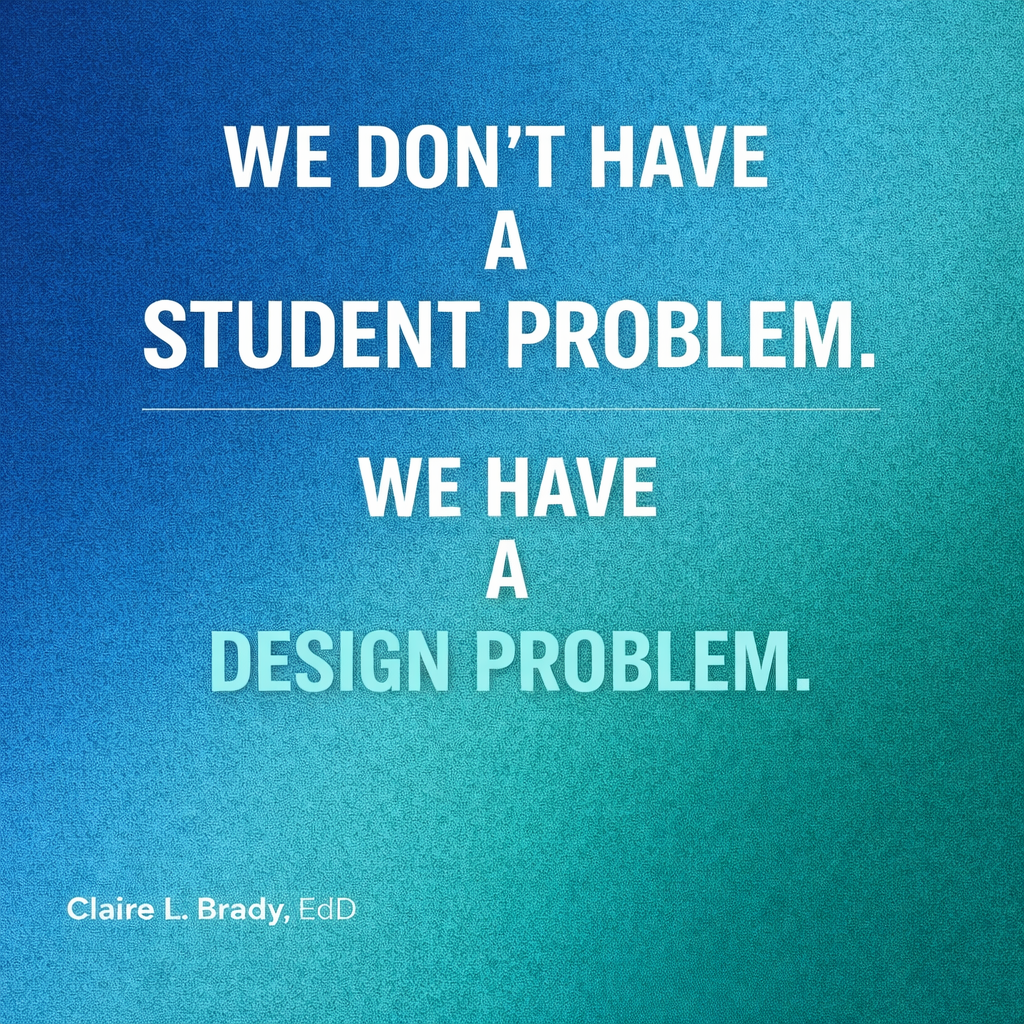
Today’s students are not a variation of the “traditional” student. They are the majority. They are working, parenting, transferring, stopping out, and coming back. They are learning online, commuting, and building lives alongside their education. And yet, many of our systems still quietly ask: What if they behaved more like the students we used to have?
That gap—between who students are and how institutions are designed—is where the real risk lives:
Not just enrollment risk.
Not just financial risk.
Mission risk.
And then there’s AI. But let’s be clear: AI is not the disruption. It’s the mirror. It is showing us—quickly and uncomfortably—where our systems no longer match our students.
It is forcing questions we have been able to postpone:
What actually demonstrates learning?
What is a degree signaling now?
What parts of the college experience are essential—and which are inherited?
These are not new questions. But AI is making them harder to ignore.
So where do we go from here?
Mintz outlines multiple possible futures for higher education—from elite, high-touch institutions to competency-based and hybrid models. But the question for leaders is not which model will win. It is this: Are we willing to design for the students we actually serve? Or will we continue to preserve structures that were never built with them in mind?
Three questions I would offer to higher education leaders:
1) Who is your institution truly designed for?
Not who you say you serve—but who your systems actually work for. Look at your schedules, advising structures, course sequencing, financial aid timelines, and expectations for engagement. Who can move through your institution with relative ease? And who has to constantly adapt, navigate, and compensate? Because students shouldn’t have to be exceptional navigators to be successful.
2) Where are you adding flexibility vs. redesigning structure?
Flexibility is not transformation. Online options, extended hours, multiple modalities—these matter. But if the underlying model remains unchanged, we’re asking students to fit into a system that still wasn’t built for them. Where are you truly rethinking how learning is structured, assessed, and supported? And where are you simply layering options onto an inherited design?
3) What would you build if you started today?
Not constrained by tradition, policy, or precedent—just by purpose. If you were designing an institution for today’s students—students balancing work, caregiving, and complex lives—what would be different? What would you prioritize? What would you let go of? What would you refuse to carry forward simply because “it’s how we’ve always done it”?
Closing Thoughts
The future of higher education won’t be built by preserving the model. It will be built by leaders willing to reimagine it. Higher education changed my life. And right now, we have a choice: Design for the students we have—or keep optimizing for the ones we wish we had.
Read the full Chronicle article here: https://www.chronicle.com/article/the-end-of-higher-eds-status-quo (may require you to log in)
Note: Image created using ChatGPT.
